2026 Top LED Ceiling Light Types for Global Buyers?
The 2026 Led Ceiling Light market is moving beyond simple brightness. Global buyers now compare energy use, optical comfort, controls, installation, and long-term reliability. The International Energy Agency reports that lighting accounts for roughly 15% of global electricity consumption. It also identifies LEDs as a major efficiency opportunity. That evidence makes ceiling-light selection an operational decision, not merely a decorative choice.
This guide examines the leading Led Ceiling Light types expected to attract international demand in 2026. These include integrated LED panels, slim surface-mounted fixtures, recessed downlights, smart ceiling lights, motion-sensing models, and tunable-white systems. Grand View Research continues to identify LED lighting as a strong-growth technology, supported by energy-efficiency upgrades and smart-building adoption. The U.S. Department of Energy also reports continuing progress in LED efficacy, controls, and solid-state lighting performance. Yet higher efficiency does not automatically mean better lighting.
Details matter.
A showroom may look impressive under a cool-white fixture, while a hotel room needs softer, controlled illumination. A low-profile panel can simplify installation, but its driver may be difficult to replace. Smart functions can add value, although poor software support may shorten practical product life. Buyers should therefore examine lumen maintenance, color rendering, flicker performance, ingress protection, warranty terms, and regional certification requirements. These points reflect common sourcing experience, but product claims still require independent verification. Some market forecasts also differ because researchers define “smart lighting” and “ceiling lighting” differently. This guide keeps that limitation visible while comparing the most relevant 2026 types for distributors, contractors, hospitality projects, and residential developers.
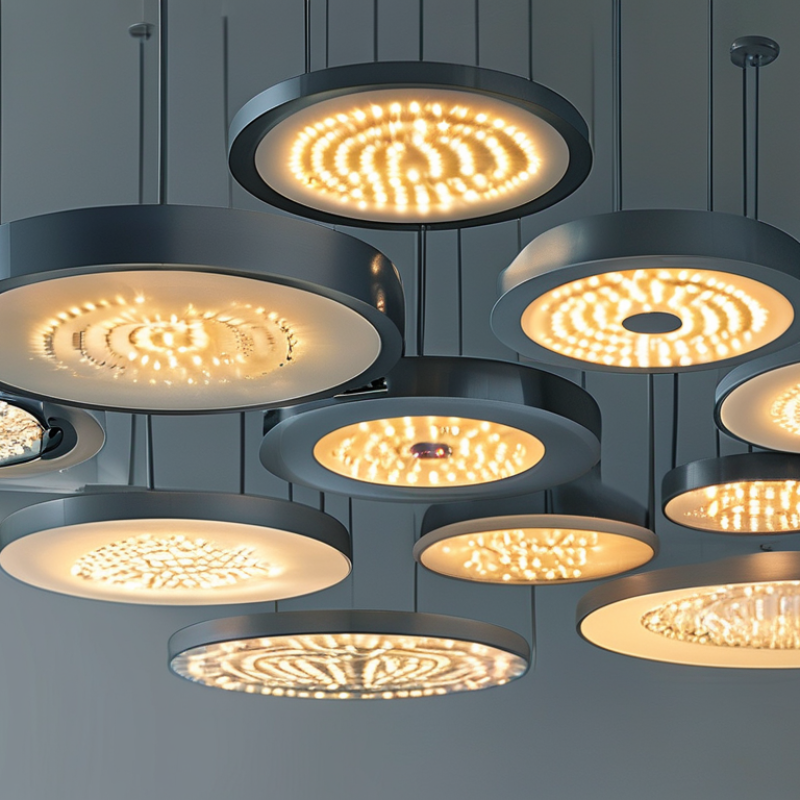
LED Ceiling Light Basics and Key Features for Global Buyers
LED Ceiling Light Basics and Key Features for Global Buyers
LED ceiling lights now include flush mounts, semi-flush fixtures, panel lights, and adjustable downlight designs. Each type serves a different ceiling height, room size, and installation method. Flush mounts suit low ceilings because their housings sit close to the surface. Semi-flush models add visual depth, but they need more overhead clearance. Panels create broad, even light in offices, corridors, and commercial rooms.
Global buyers should check lumens, color temperature, color rendering index, and beam distribution. Lumens describe brightness more accurately than wattage. A 3,000K light feels warm, while 4,000K often suits offices and kitchens. A CRI of 80 is common, but higher values show product colors more naturally. Small details matter. Flicker performance, diffuser quality, and heat dissipation affect daily comfort and service life.
Input voltage must match the destination market. Confirm dimmer compatibility before ordering, especially with phase-cut or smart controls. For bathrooms or covered outdoor areas, verify the appropriate ingress protection rating. Also request installation drawings, test reports, and required market approvals. In practical inspections, loose terminals and thin mounting plates remain easy faults to miss. I once focused too much on appearance. That was a mistake. A beautiful fixture still fails when the driver overheats, the light flickers, or replacement parts cannot be sourced. Temperature testing and sample installation deserve more attention than glossy catalog images.
2026 Top LED Ceiling Light Types for Global Buyers? - LED Ceiling Light Basics and Key Features for Global Buyers
Comparative guide to common LED ceiling light types and specifications for international sourcing | LED Ceiling Light Type | Typical Power Range | Typical Luminous Flux | Common Color Temperature | Typical CRI | Recommended Applications | Key Features | Global Buyer Checklist |
| Flush-Mount LED Ceiling Light | 12–36 W | 900–3,600 lm | 2,700–6,500 K | 80–90+ | Bedrooms, hallways, kitchens, offices | Low profile, broad diffusion, simple installation | Check ceiling junction-box compatibility, diffuser material, and driver replacement options |
| Slim Panel Light | 18–48 W | 1,500–4,800 lm | 3,000–6,500 K | 80–90+ | Offices, schools, retail areas, corridors | Uniform light, thin housing, low glare options | Verify recessed, surface, or suspended mounting and required cut-out dimensions |
| Round Surface-Mounted Light | 12–30 W | 900–2,700 lm | 3,000–6,500 K | 80–90 | Apartments, utility rooms, small commercial spaces | Compact housing, easy retrofit, multiple diameters | Confirm mounting plate design, input voltage, and terminal type |
| Recessed Downlight | 6–24 W | 500–2,200 lm | 2,700–6,500 K | 80–95 | Residential rooms, hospitality, retail displays | Directional beam, trim choices, dimming capability | Measure ceiling thickness and cut-out size; confirm insulation-contact rating where required |
| LED Troffer or Grid Ceiling Fixture | 25–50 W | 2,500–5,500 lm | 3,500–6,500 K | 80–90+ | Offices, classrooms, healthcare facilities | Fits modular ceilings, wide distribution, optional low-glare optics | Confirm ceiling-grid size, glare rating, emergency option, and local electrical compliance |
| Decorative LED Ceiling Fixture | 20–80 W | 1,500–7,000 lm | 2,700–4,000 K | 80–90 | Dining areas, hotels, residences, reception spaces | Visual design focus, layered illumination, optional remote control | Review packed dimensions, suspension hardware, assembly instructions, and weight limits |
| Bathroom or Damp-Location Ceiling Light | 12–30 W | 900–3,000 lm | 3,000–6,500 K | 80–90 | Bathrooms, laundry rooms, covered outdoor areas | Sealed housing, moisture resistance, easy-clean diffuser | Select an appropriate IP rating for the installation zone and confirm test documentation |
| Smart or Sensor-Equipped Ceiling Light | 15–40 W | 1,200–4,000 lm | 2,700–6,500 K | 80–90 | Homes, offices, corridors, shared facilities | Occupancy sensing, scheduling, dimming, adjustable color | Check wireless protocol, app compatibility, data privacy, standby power, and regional frequency requirements |
Specification note: Performance ranges are typical market values and vary by optical design, LED efficacy, driver quality, housing size, ambient temperature, and testing method. Buyers should request photometric files, safety documents, warranty terms, and samples before placing a bulk order.
Main LED Ceiling Light Types and Their Best Applications
2026 Top LED Ceiling Light Types for Global Buyers
Main LED Ceiling Light Types and Their Best Applications
LED ceiling lights now serve very different spaces, from compact apartments to large retail halls. Choosing the right type depends on ceiling height, room use, light distribution, and local electrical requirements.
Flush mount lights sit close to the ceiling and suit bedrooms, corridors, and low-ceiling offices. They reduce visual clutter and usually offer simple installation. Recessed downlights create focused beams for kitchens, galleries, and hospitality areas. Their trim size, beam angle, and cutout depth must match the ceiling structure. Measure twice.
Backlit LED panels provide even, low-glare illumination across offices, schools, and healthcare rooms. They work well where screens or paperwork require comfortable lighting. Surface-mounted panels can replace recessed products when the ceiling is concrete or difficult to modify. For warehouses and workshops, high-bay lights deliver stronger output from greater heights, while moisture-resistant ceiling lights fit bathrooms, balconies, and covered outdoor spaces. Check the IP rating carefully. That detail matters.
For residential projects, adjustable color temperature can shift from cool task lighting to warmer evening light. A high color rendering index helps reveal food, fabrics, and product colors more naturally. Global buyers should verify input voltage, driver quality, flicker performance, certifications, and warranty terms before ordering. I have seen projects select attractive fixtures first, then discover incompatible voltage or insufficient ceiling clearance. Specifications are not decoration. They are part of the installation plan..sulake
Global Safety Standards, Certifications, and Installation Requirements
2026 Top LED Ceiling Light Types for Global Buyers?
Global buyers should treat safety compliance as a design requirement, not a final paperwork step. The IEC 60598-1 standard covers general luminaire safety, including insulation, creepage distances, temperature, and mechanical strength. Fixed ceiling lights commonly require IEC 60598-2-1 testing. Their drivers may also need IEC 61347 safety approval and IEC 62471 photobiological assessment. Not enough.
Regional approval still matters. European shipments typically require CE compliance, while North American projects often reference UL 1598 and UL 8750. The CB Scheme can simplify international evidence, but it does not replace local approval. Check voltage, frequency, earthing, EMC performance, and dimmer compatibility before ordering. A 220–240 V fixture is not automatically suitable for every 230 V installation.
Installation details can prevent expensive failures. Confirm the junction box rating, ceiling substrate, mounting screws, driver clearance, and heat dissipation space. Select IP44 or higher for damp areas, based on local code and risk assessment. A qualified electrician should verify circuit protection and emergency isolation. In practical inspections, loose terminals and trapped drivers appear more often than dramatic product defects. Small errors matter.
The U.S. Department of Energy reports that LED products can use at least 75% less energy and last up to 25 times longer than incandescent lamps. UNEP’s 2024 Global Status Report states that buildings consumed about 32% of global energy in 2023. Efficiency helps, but certification marks alone cannot confirm every installation condition. Buyers should request current test reports, factory control records, and clear installation instructions. Some suppliers provide excellent documents; others provide only attractive labels. That difference deserves scrutiny.
Buying Factors, Supplier Selection, and Market Trends in 2026
In 2026, global buyers will compare more than brightness and price when choosing LED ceiling lights. Common options include slim edge-lit panels, recessed downlights, surface-mounted fixtures, and tunable white models. The International Energy Agency reports that lighting uses about 15% of global electricity. Therefore, efficacy matters, especially in hotels, warehouses, and offices with long operating hours. Buyers should check delivered lumens, watts, color rendering index, flicker performance, glare rating, and expected lifetime. A bright fixture can still create uncomfortable ceiling reflections.
Market trends are moving toward connected controls, sensor-based dimming, and lower-carbon materials. The U.S. Department of Energy’s Solid-State Lighting reports have repeatedly linked LED adoption with major efficiency gains and longer service life. However, smart functions can add failure points. Not every connected ceiling light creates real savings. A reliable supplier should provide photometric files, safety test reports, thermal data, and clear warranty terms. Ask for LM-80 and TM-21 evidence when applicable. Verify compliance with the destination market’s electrical and energy rules. Sample testing should include heat buildup, repeated switching, dimming compatibility, and visible flicker.
Supplier selection also requires operational evidence. Review production capacity, component traceability, quality-control records, and replacement-part availability. ISO 9001 certification can support confidence, but it does not replace independent testing. I have seen attractive samples perform poorly after installation. That risk is easy to underestimate. Buyers should compare five-year energy costs, failure handling, packaging damage rates, and lead times, not only the purchase invoice. Repairable designs may become more valuable as circular-economy policies and commercial sustainability reporting expand.
2026 Top LED Ceiling Light Types for Global Buyers
Indicative commercial efficacy benchmarks by ceiling-light type, expressed in lumens per watt (lm/W).
Higher efficacy can reduce electricity use, but buyers should also compare glare control, color rendering, lifetime, warranty, dimming compatibility, safety certifications, ingress protection, and regional energy requirements. The figures are practical 2026 planning benchmarks rather than market-share data.

